.png)

.svg)
%20-%20blue.jpeg)

22/10/2026
The world of search is undergoing its most significant transformation since Google first appeared. If you’ve spent any time on LinkedIn or reading industry news, you’ll have noticed the growing buzz around GEO (Generative Engine Optimisation). It’s a new, complex subject, and there’s no shortage of conflicting opinions.
This article, inspired by our keynote “From SEO to GEO – gaining visibility in the age of generative engines” at Tech for Retail 2025, aims to demystify GEO and highlight its fundamental differences with SEO. We’ll explain how ChatGPT really works, why traditional SEO methods don’t apply to GEO, and what the future may hold for ChatGPT. It’s vital for digital leaders to develop a critical eye, so as not to take everything labelled – or sold – as GEO at face value.
How does ChatGPT generate its answers?
To understand GEO, you need to look under the bonnet. Contrary to popular belief, ChatGPT doesn’t just “spit out” its training data. When connected to the web, its process is far more sophisticated.
Let’s use a simple example: “best Italian restaurants in Paris”. The video below shows what’s really happening:
How ChatGPT works, illustrated
Process overview
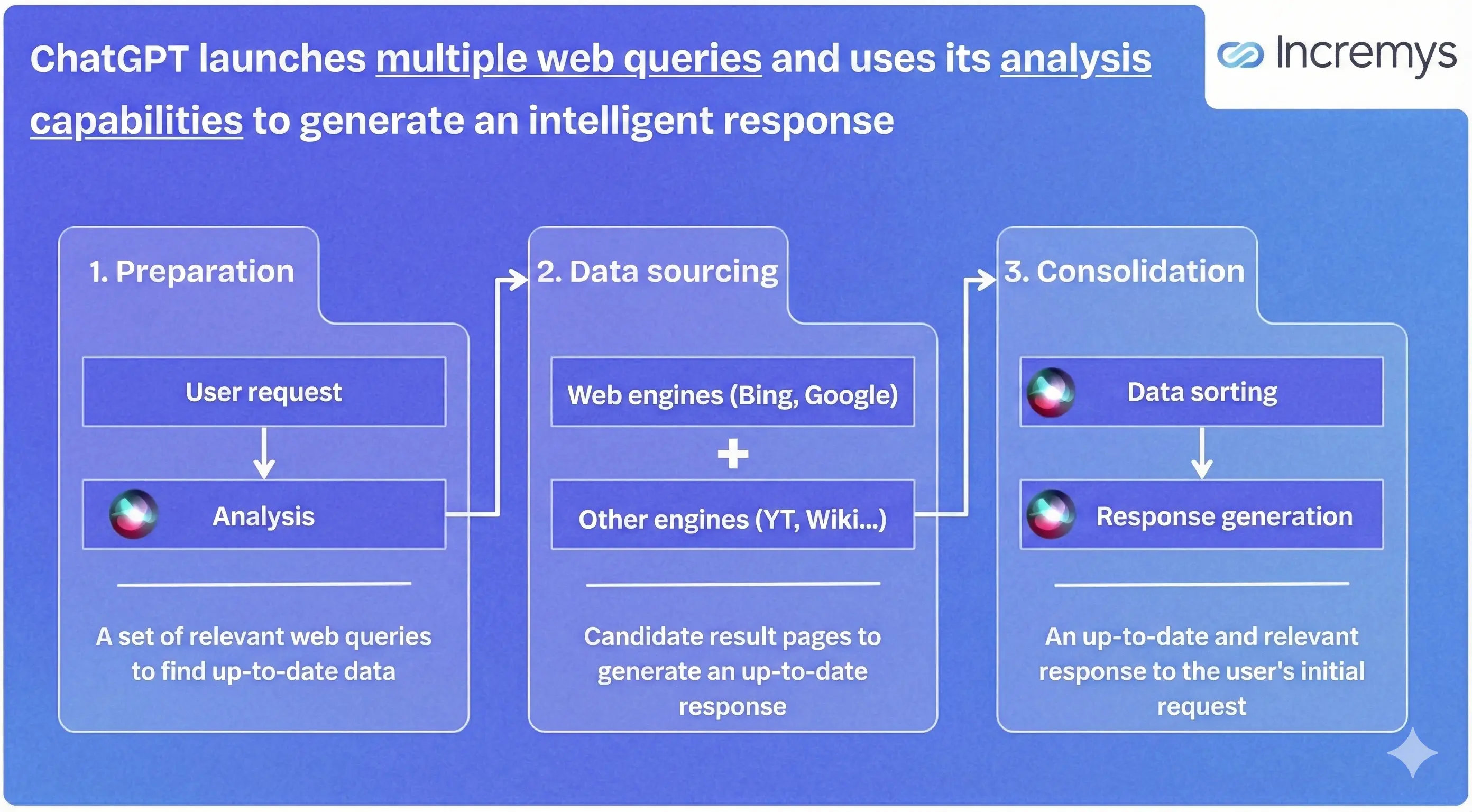
When you ask ChatGPT this question, a complex sequence is triggered – a far cry from the simple index lookup we’re used to with Google:
- Identifying the need: The AI analyses whether the query requires up-to-date information that isn’t in its historical training data. It then generates multiple queries: this is where the magic happens. ChatGPT doesn’t just focus on one query – it creates a cluster of related, semantically relevant searches. For our example, it will look for “top Italian restaurant”, but also “Neapolitan pizzeria in Paris”.
- Multi-engine data sourcing: ChatGPT doesn’t just use a standard web engine (URL listings). It programmatically queries other databases such as YouTube and Wikipedia.
- Consolidation and fact-checking: It filters the results, removes the noise, and synthesises an answer, citing its sources so users can check the information for themselves.
In short, ChatGPT acts as a super-aggregator – preparing, sourcing, sorting and consolidating information before serving it up.
The importance of the persona
If you stop at the technical explanation above, you’ll miss the real point. The video below highlights the fundamental difference between SEO and GEO:
The importance of the persona
The video above demonstrates a revealing simulation:
- Scenario A: a neutral query asks for the best Italians. Result: classic, mostly upmarket addresses.
- Scenario B: a user introduces himself as a sales rep who’s had a tough time, is short on cash, has missed his targets again, and wants to cheer himself up with his girlfriend. Result: ChatGPT suggests comforting, more affordable pizzerias (£20–30), with an atmosphere to match the user’s mood.
In traditional SEO, whether you’re a student, an executive or anyone else, if you type “Italian restaurant Paris”, Google will give you more or less the same answer (TripAdvisor, The Fork, etc.). The answer is unique and standardised. In GEO, there’s no single answer: there’s a response for each user.
The persona is a major structural shift. SEO is an old technology that returns identical results; GEO generates personalised answers. If your GEO strategy doesn’t take personas into account, it’s bound to fail.
The new paradigm of GEO
Boosting visibility in generative AI search engines
Now we’ve established that personalisation is key, how do you audit and improve your visibility? It’s time to move on from traditional ranking tracking tools.

Principles for measuring GEO visibility
Measuring your presence in ChatGPT requires a rigorous approach to avoid misleading data. Three principles should guide your method:
- Define your persona: You must define your brand, your audience and your target personas. If you don’t, the results returned by AI won’t reflect your real customers. Is your brand visible to a “busy young urbanite” or a “technical expert”? The answer will differ.
- Simulate a conversation (not just a prompt): Forget highly structured prompts like “Act as an expert and give me the list in JSON format”. That’s computer science, not real life. You need to simulate a natural conversation, because ChatGPT is a conversational agent.
- Use the real engine (live search): Beware of tools that promise thousands of analyses for a few pounds. Using ChatGPT with live web search is expensive (50 to 100 times more than a standard query). If the tool doesn’t use real-time web access, the analysis is out of date.
GEO: a snapshot of your brand’s content visibility across the web
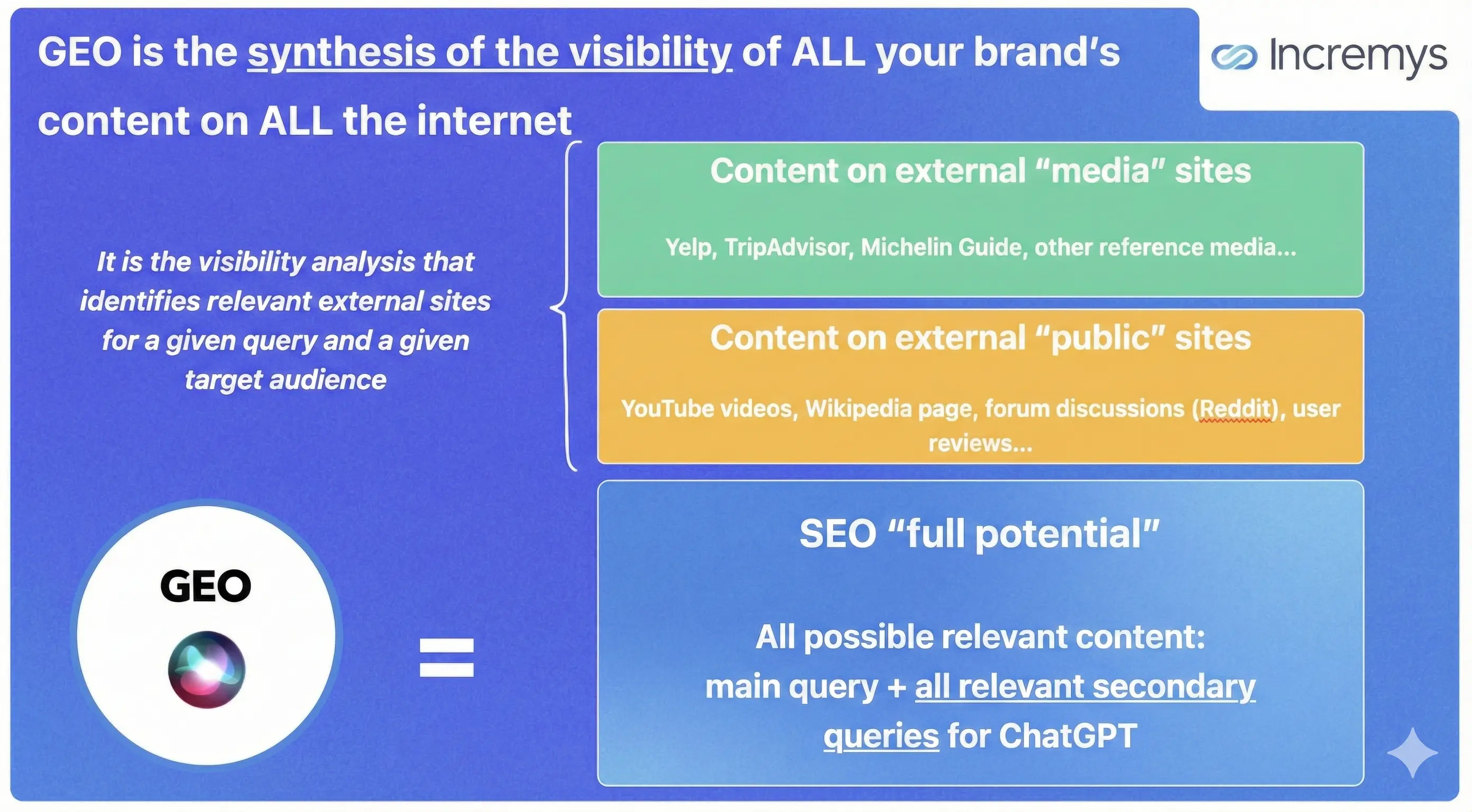
GEO isn’t just about optimising your website. It’s the sum of your brand’s visibility from all content available online. To succeed, you need to activate three levers at once:
- “Full potential” SEO (your own site): It’s no longer enough to target the main keyword. Since ChatGPT generates dozens of related queries, your site must cover a much broader semantic field (secondary queries). This means producing relevant content at scale.
- External public sites: This is the big shift. ChatGPT sources information from where people talk. Reddit, user reviews, Wikipedia pages and YouTube videos are all primary sources. A brand must be visible and positively mentioned on these platforms.
- External media sites (Digital PR): Mentions on authoritative sites are still crucial. However, the goal is no longer just SEO “link juice”, but brand citations on a specific theme by a trusted media outlet.
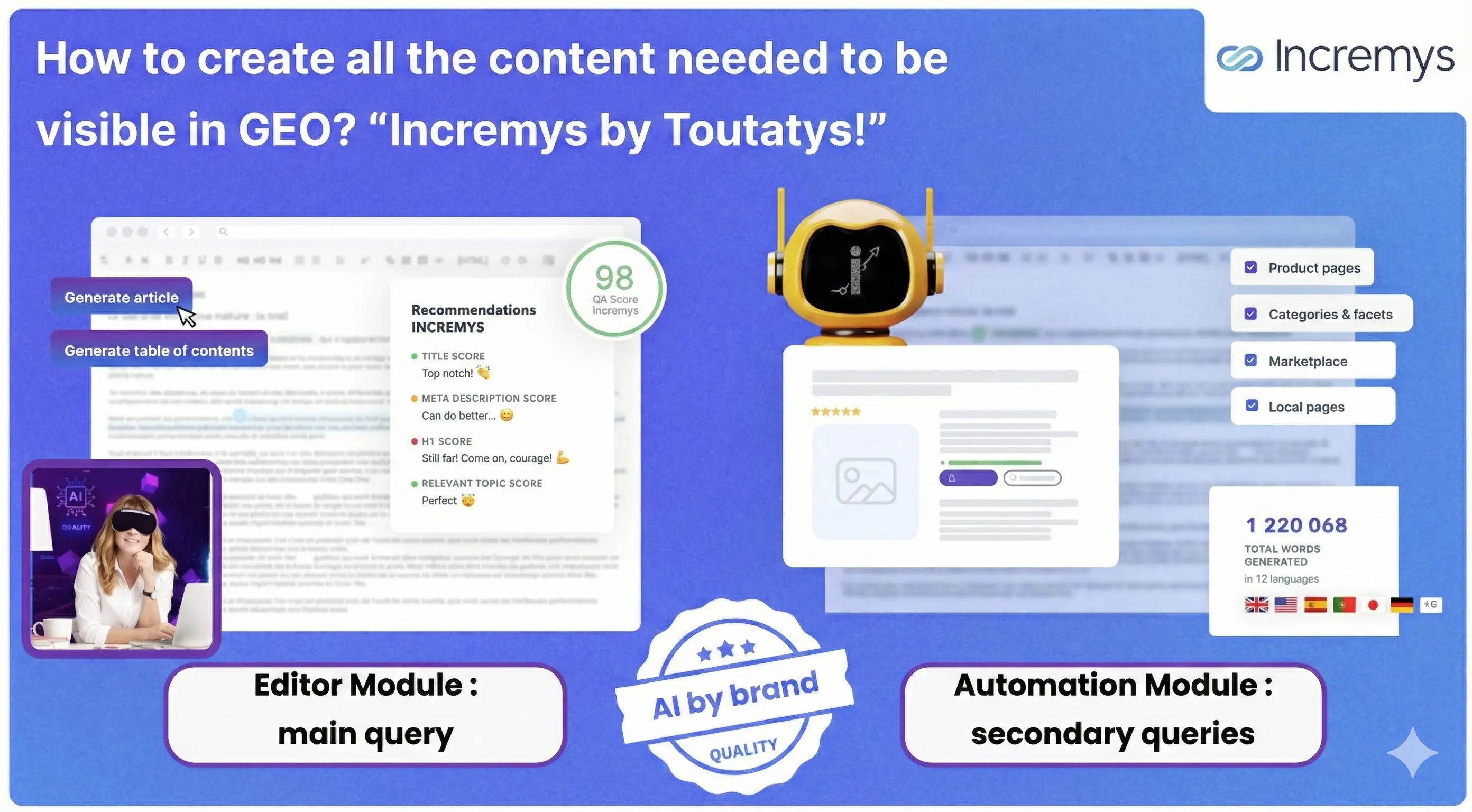
GEO: how to create all this content – Incremys to the rescue!
Our platform offers a range of tools for content creation, such as the AI-assisted text editor and our automation module.
Comparison table: SEO vs GEO
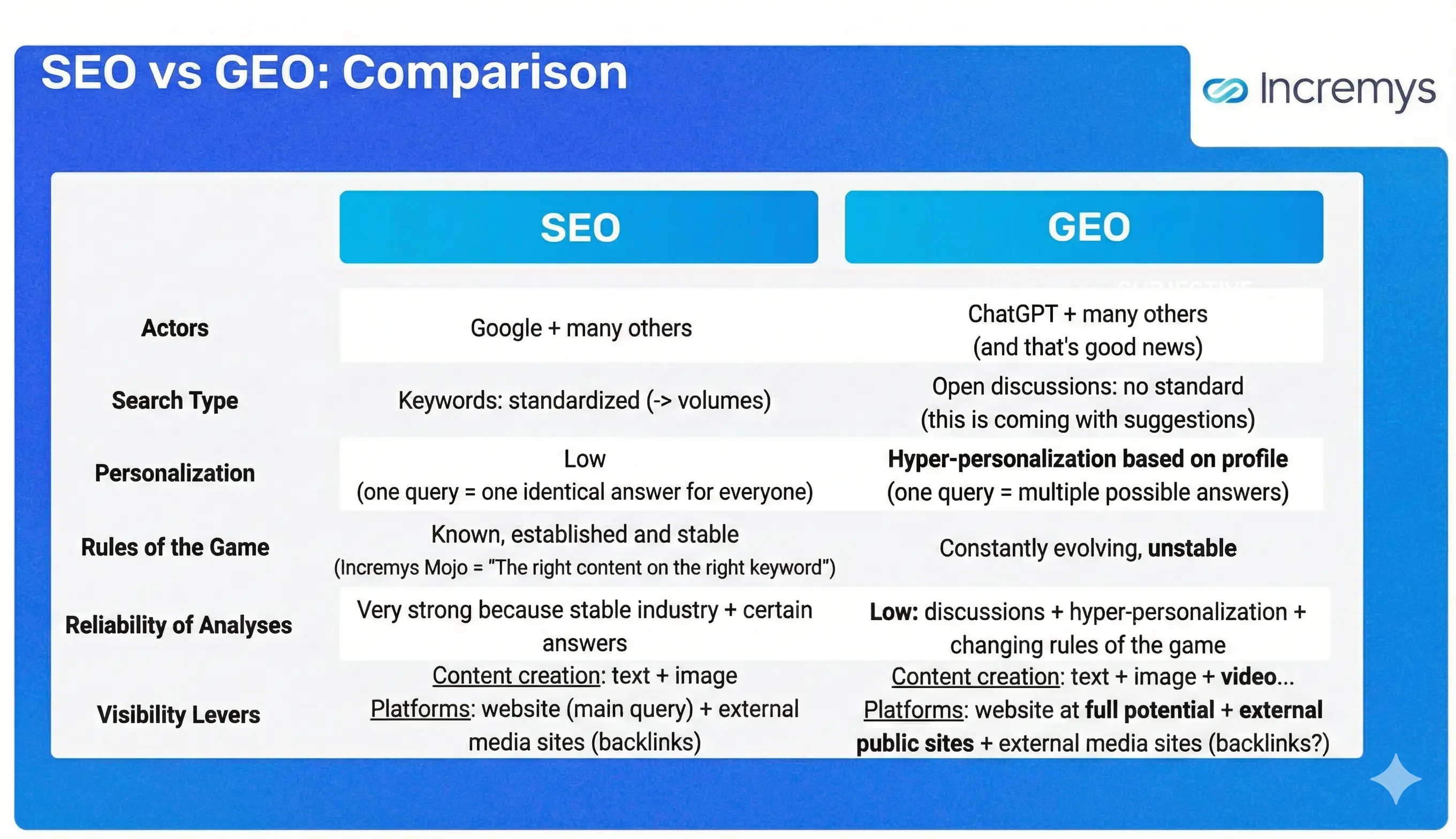
To clearly illustrate the gulf between these two disciplines, here’s a point-by-point comparison from Incremys’ analysis:
SEO vs GEO: yin / yang
The table below highlights the fundamental differences between SEO and GEO:
The future of ChatGPT and the evolution of search
To understand where we’re heading, it’s worth looking at where we’ve come from. The evolution of ChatGPT closely mirrors Google’s, only at a much faster pace.
Technological mimicry
Google used to be a list of blue links. Today, it’s enhanced with images, maps and videos. ChatGPT is following a similar path. From a simple text box, it’s become a search engine capable of delivering illustrated tutorials, embedded YouTube videos and cited sources.
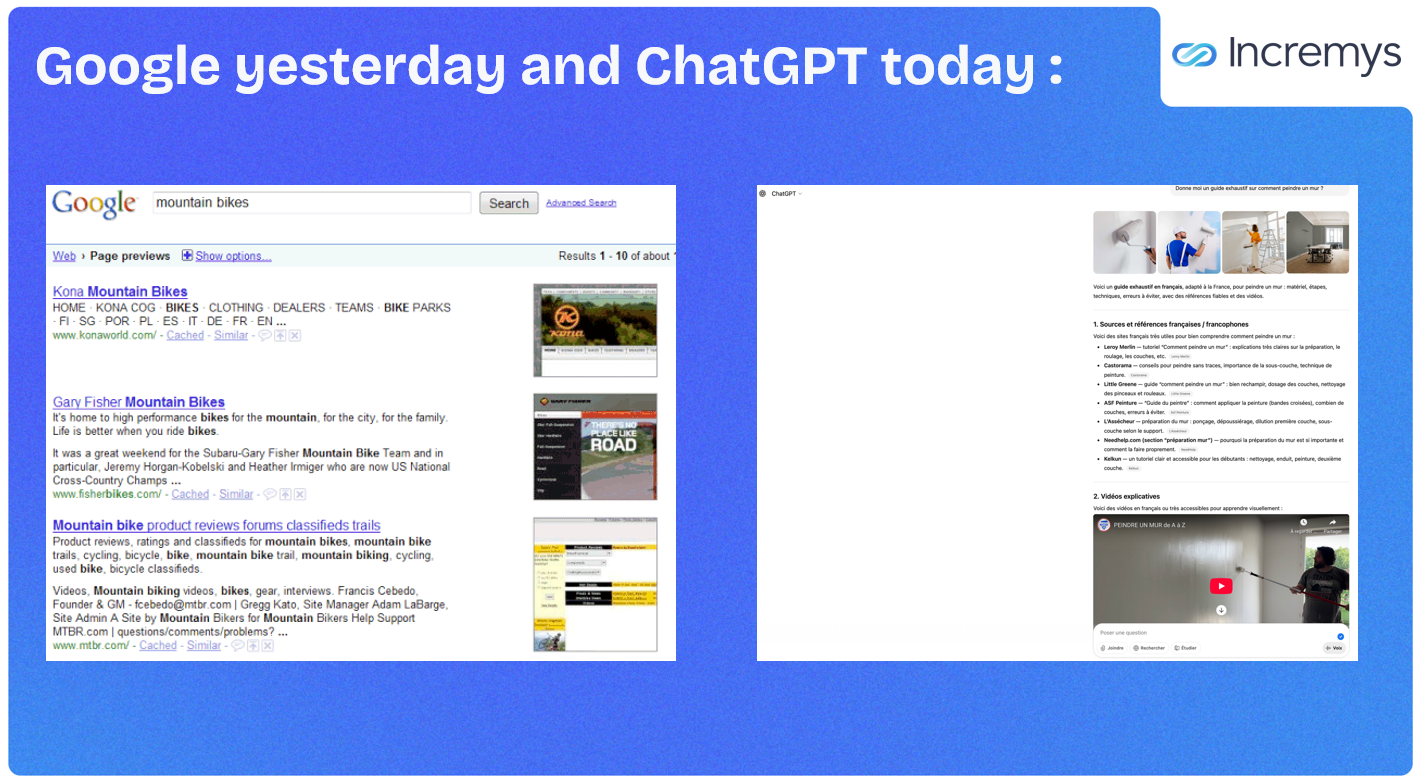
OpenAI doesn’t need to reinvent the wheel. They have a technological edge and can simply adopt the strategies that made previous web giants successful.
The three future dimensions of GEO
Three key trends will shape ChatGPT’s commercial future – and, by extension, your visibility strategy:
1. The inevitable arrival of advertising
Despite Sam Altman’s initial statements (much like those of Zuckerberg or Google’s founders in their early days), advertising is coming. The infrastructure costs (GPUs, computing power) are enormous, far higher than Google’s at the start. The aim is to monetise a vast audience. For brands, this means there will soon be a “Google Ads” for GEO.
2. The “super-app” model (SDKs and apps)
This is probably the most critical point. ChatGPT is moving towards a model similar to WeChat in China. WeChat isn’t just a messaging app – it’s an operating system where 1.4 billion users interact with brands via “mini-apps”.
With almost a billion users, ChatGPT will soon let brands develop their own apps within the interface. Imagine ordering pizza, booking a taxi or managing your clients directly in the ChatGPT chat. This is where true customer acquisition will happen.
3. Addiction and the ultimate assistant
Finally, the psychological aspect will be crucial. By combining TikTok’s addictive algorithm with hyper-personalisation, ChatGPT will become a “life assistant” or “best friend”. It’ll know everything about you, remember everything, and proactively suggest things (push notifications: “It’s Saturday, fancy Italian like last time? Shall I book the restaurant and taxi?”).
The line between human and machine will blur even further, creating a closed ecosystem users rarely leave.

Conclusion
The move from SEO to GEO isn’t just another algorithm update. It’s a complete change in mindset and approach.
SEO was a battle for position on anonymous keywords. GEO is a battle for conversational relevance with targeted audiences (personas).
For brands, the message is clear: this isn’t SEO. Yesterday’s methods won’t be enough. From today, you need to:
- Produce content at scale to cover every relevant semantic nuance in both SEO and GEO.
- Invest in public discussion spaces (Reddit, verified reviews, Wikipedia, YouTube, etc.).
- Define your personas to audit your real visibility and implement a highly personalised marketing strategy.
GEO opens up targeting and personalisation opportunities that SEO could never offer. Those who realise that the conversation is now with a personalised assistant – not a search engine – will have a huge head start.
To move from demonstration to practice, the Incremys platform emulates your personas in AI engines, reads what they ask and who gets cited, and turns it into a unified brief before producing content in your Brand DNA. What it does in place of an agency is detailed on our GEO & SEO agency page.


.jpeg)
.svg)
.svg)
.jpeg)

%2520-%2520blue.jpeg)
.avif)